
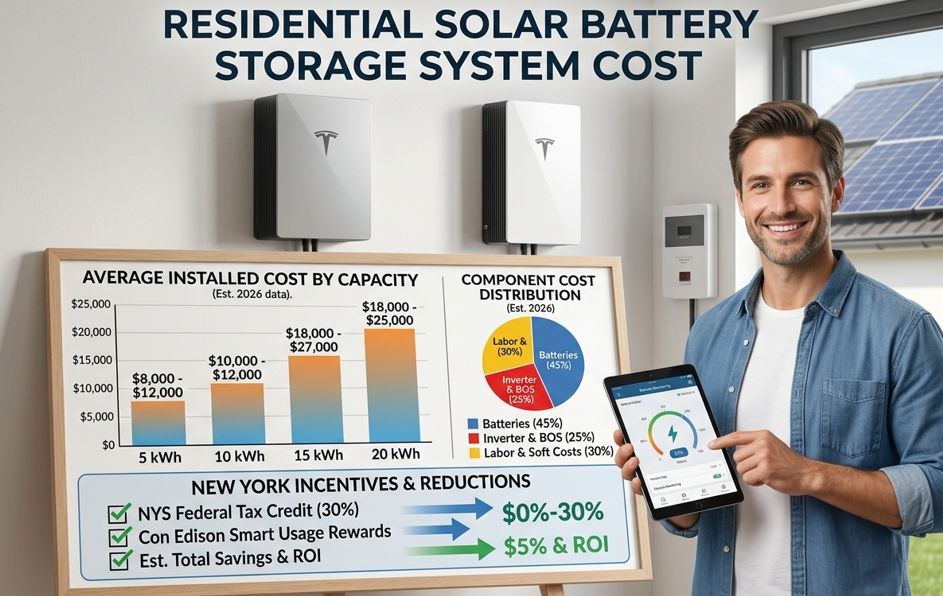
Residential Solar Battery Storage System Cost
Imagine having a giant, rechargeable battery for your entire house. When the sun is shining, your solar panels make more power than you can actually use. Instead of sending that extra energy back to the electric company, you can save it for later. In 2026, adding a battery to your home is becoming one of the most popular ways to go solar, but it does change your budget.
Let’s look at the residential solar battery storage system cost and why many families think it is worth the extra investment.
What is the Average Price for a Battery?
Adding energy storage to your home is a bit like adding a high-tech appliance. In 2026, the residential solar battery storage system cost usually ranges from $9,000 to $14,000 for a single battery.
This price includes:
- The Battery Itself: This is the hardware, like a Tesla Powerwall or an Enphase IQ Battery, which sits in your garage or on the side of your house.
- The Battery Inverter: Batteries need a special “brain” to turn their stored power into electricity your lights and gadgets can use.
- Installation: Professional electricians have to wire the battery into your home’s main electrical panel so it knows when to turn on.
Why is the Cost So High?
You might wonder why a solar battery costs as much as a small car. It comes down to the materials inside. Most home batteries use lithium-ion technology, which is the same stuff found in high-end electric cars and smartphones. These materials are expensive, and the batteries have to be built extremely tough to stay safe and last for 10 years or more.
In 2026, even though more batteries are being made than ever before, the price hasn’t dropped as fast as people hoped because the demand for these materials is so high all over the world.
Do You Need More Than One?
One of the biggest factors in your residential solar battery storage system cost is how much power you want to “back up”.
- One Battery: Usually enough to keep your lights, fridge, internet, and phone chargers running during a power outage.
- Two or More Batteries: Necessary if you want to run big “energy hogs” like your air conditioner, clothes dryer, or an electric oven when the grid is down.
Most families start with one battery and see how it goes, as you can often add a second one later if you decide you need more backup power.
How the Government Helps You Pay
The best news about the residential solar battery storage system cost is that the government helps you pay for it! In 2026, you can use the 30% Federal Tax Credit for your battery, even if you buy it separately from your solar panels.
If your battery installation costs $12,000, the government gives you a $3,600 credit on your taxes. This brings your real cost down to $8,400. Some states, like California or New York, even offer extra rebates that can save you even more.
Is It Worth It?
While a battery adds to your total bill, it gives you something money can’t always buy: peace of mind.
- Blackout Protection: When the rest of the neighborhood goes dark during a storm, your lights stay on.
- Nighttime Savings: You can use your own stored “sun power” at night instead of buying expensive electricity from the utility company.
- Energy Independence: You rely less on the electric company and more on yourself.
Final Thoughts
In 2026, a solar battery is the ultimate “accessory” for a modern home. While the residential solar battery storage system cost is an extra step in your budget, the ability to store the sun’s power and use it whenever you want is a game-changer for any family looking to go green!