
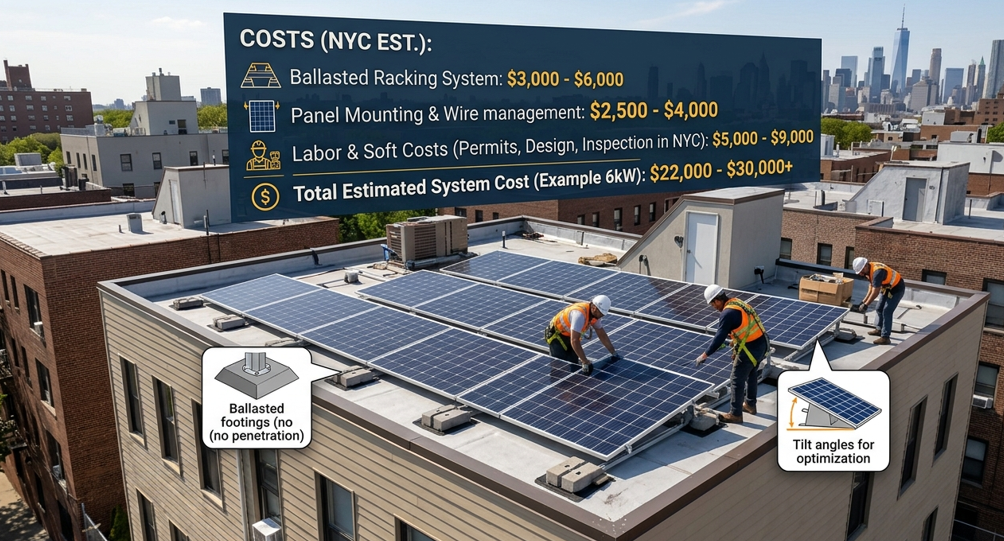
Solar Panel Installation Cost for Flat Roof
If you look at most houses with solar panels, the panels are usually slanted to match the angle of the roof. But what if your home or garage has a roof that is perfectly level? You might wonder if you can even go solar, or if it will cost a fortune to set up. The good news is that flat roofs are actually great for solar power, although the solar panel installation cost for a flat roof involves a few extra steps.
In 2026, many modern homes and city buildings use flat roofs to maximize space, and solar technology has caught up to make these installations simple and efficient.
Do Flat Roofs Cost More?
The short answer is yes, but usually only by a small amount. For a standard-sized home system in 2026, you can expect to pay about $1,000 to $2,000 more than you would for a slanted roof.
Why the extra cost? It mostly comes down to the equipment used to hold the panels. On a slanted roof, the panels just lay flat against the surface. On a flat roof, if you laid the panels completely flat, they wouldn’t catch much sunlight, and rainwater and dirt would puddle on top of them. To fix this, installers use tilt racks. These metal frames prop the panels up at an angle so they can “see” the sun better and let the rain wash them clean.
The Benefits of a Flat Roof
Even though the solar panel installation cost for a flat roof is slightly higher due to the racking, there are some big benefits that might actually save you money in the long run:
- Easier Labor: It is much easier (and safer!) for workers to walk around on a flat roof than a steep, slippery one. This can sometimes make the installation go faster.
- Perfect Angling: With a slanted roof, you are stuck with whatever direction your house faces. With a flat roof, installers can turn the tilt racks to face the exact south-facing direction where the sun is strongest.
- Invisible from the Street: If you don’t like the look of big panels on your house, flat roof systems are often “invisible” from the ground because they sit lower than the edge of the roof.
Keeping Your Roof Safe and Dry
One thing that often worries homeowners is whether the tilt racks will cause leaks. In 2026, most flat roof systems use ballasted mounts. This is a fancy way of saying the racks are held down by heavy concrete blocks instead of being screwed into your roof.
Because the workers don’t have to poke holes in your roof, your warranty stays safe, and you don’t have to worry about water getting inside. It is like putting a very heavy weighted blanket over your roof to keep the panels from blowing away during a storm.
Saving with the 30% Tax Credit
Just like any other solar project, the solar panel installation cost for a flat roof qualifies for the 30% Federal Tax Credit in 2026. This credit covers the panels, the workers, and—most importantly—those extra tilt racks and concrete blocks.
If your total flat roof project costs $23,000, the government gives you a $6,900 credit on your taxes, bringing your real cost down to $16,100.
Final Thoughts
A flat roof shouldn’t stop you from joining the solar revolution. While you might pay a little more for the special racks to tilt your panels toward the sun, the ability to aim them perfectly often means you’ll make more electricity and save more money on your bills. If you have a flat roof and plenty of sunshine, 2026 is a fantastic year to start making your own power!