
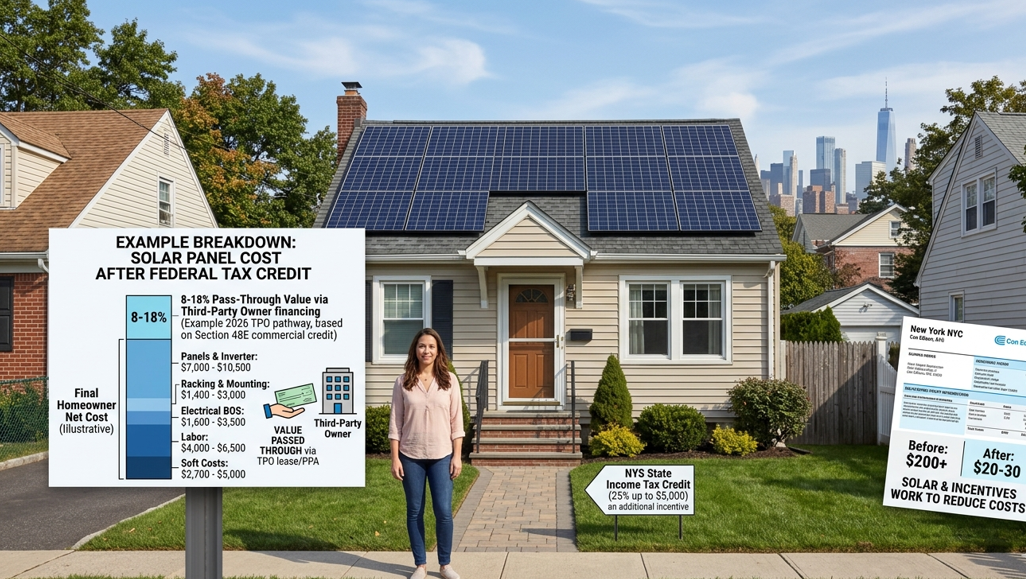
Solar Panel Cost After Federal Tax Credit
When you look at the price tag for a new solar energy system in 2026, it can feel a little like looking at the sticker price of a brand-new car. It’s a big number! But there is a secret weapon that almost every homeowner in America can use to make that price much more affordable. It is called the Federal Investment Tax Credit, or ITC for short.
Understanding the solar panel cost after the federal tax credit is the most important step in figuring out your actual budget. Let’s look at how this “government discount” works and how much money it can actually put back in your pocket.
What Exactly is the Federal Tax Credit?
The federal tax credit is a special rule passed by the government to encourage people to use clean energy. In 2026, the credit is set at 30%. This means the government will basically pay for nearly one-third of your entire solar project.
It is important to know that this is a tax credit, not a rebate. A rebate is like a check you get in the mail. A tax credit is even better—it is a dollar-for-dollar reduction in the amount of income tax you owe to the government. If you owe $10,000 in taxes at the end of the year and you have a $6,000 solar credit, you only have to pay $4,000!
Doing the Math: The Real Cost
To find the solar panel cost after the federal tax credit, you just have to do a little simple multiplication. Let’s look at a few examples based on average 2026 prices:
- For a Small System: If your system costs $15,000, your 30% credit is $4,500. Your final cost is $10,500.
- For an Average System: If your system costs $22,000, your 30% credit is $6,600. Your final cost is $15,400.
- For a Large System with a Battery: If your total project costs $35,000, your 30% credit is $10,500. Your final cost is $24,500.
As you can see, the more you invest in your solar setup, the more the government helps you out.
What Does the Credit Cover?
One of the best things about the 30% credit in 2026 is that it doesn’t just cover the panels. It covers almost everything involved in the project:
- The solar panels themselves.
- The metal racks used to hold the panels on your roof.
- The “inverter” that handles the power.
- The cost of the workers who install it.
- Solar batteries (like the Tesla Powerwall) if you decide to add storage.
- Even the permits and inspection fees you pay to your city.
How Do You Get the Money?
Getting your credit is pretty straightforward, but you do have to wait until tax season. When you or your parents file your taxes for the year your solar was installed, you fill out a special form (called Form 5695).
If you don’t owe enough taxes in one year to use the whole credit, don’t worry! In 2026, you can usually “roll over” the extra amount to the next year. This ensures you get every single penny of your 30% savings.
Final Thoughts
The solar panel cost after the federal tax credit makes solar power one of the best investments you can make for your home. By taking advantage of this 30% “discount,” you aren’t just saving the planet—you are saving a massive amount of money. Just make sure you keep all your receipts from your installer so you are ready when tax time rolls around!